Whale Watching off Maui: What December Gets You, and What March Does
Updated September 25, 2026 · 8 min read
Humpback whales come to Hawaiʻi to breed and give birth, and the shallow water between Maui, Lānaʻi, Molokaʻi and Kahoʻolawe is where most of them do it. That is why a whale trip here is the cheaper and shorter boat: €43.89 against €74.64 for the cheapest snorkel trip, a median of €92.31 against €137.06, and two hours rather than a half day. The whales are close, and the boat does not have to go far.
What the listings do not tell you is that the season has two versions, and only one of them is on the booking page.
Two seasons, and the difference matters to your booking
The operators sell December to April. The Hawaiian Islands Humpback Whale National Marine Sanctuary describes something wider and sharper at the same time: the season “generally runs from November through May”, and “the usual peak in humpback abundance occurs from January through March”.
Read those two sentences against a calendar and the advice writes itself. Early December and late April are inside the commercial season and outside the peak. The boat goes out, the naturalist works hard, and the ocean is emptier than the photographs. Mid-January to mid-March is when the water in the Maui Nui basin is as full as it gets.
If your dates are fixed and they fall in December, book anyway — but book a shorter, cheaper trip and treat a sighting as the good outcome rather than the expected one. If your dates are movable, move them towards February.
The rule that decides what you will actually see
This is the part that surprises people on board, and it is worth knowing before you pay.
It is illegal to approach within 100 yards (90 metres) of a humpback whale in Hawaiian waters. The regulation covers approach “by any means” — vessels, swimmers, stand-up paddleboards, kayaks and drones alike — and aircraft must stay 1,000 feet away. If a whale surfaces closer than that, the sanctuary’s instruction to the skipper is explicit: “Stop immediately if you are within 100 yards of a humpback whale. Leave engines running and out of gear (in neutral) until the whale moves away.”
So the boat cannot take you to the whale. The whale has to come to the boat, or you watch from 100 yards. A hundred yards is the length of a football pitch, and a 15-metre humpback is perfectly visible at that distance — but it is not the view in the advertisement, and no operator can promise otherwise. What separates a good trip from a poor one at that distance is a naturalist who can read what you are looking at, and a hydrophone.
Two other numbers sit behind the rule and explain why these trips feel slow: vessels are asked to keep to 15 knots or safe planing speed at all times while transiting, and to six knots within 400 yards of whales. Collisions between boats and whales happen in Hawaiʻi every year.
The boats, and what the price buys
There are 28 whale watching trips in the Maui listings from €43.89, with a median of €92.31. The spread is not about how many whales you see. It is about the boat, the bar and the departure point.
The cheap, busy end. The two-hour narrated trip from Maʻalaea Harbour on a double-deck power catamaran is €43.89 and holds 4.6 stars across 1,091 reviews — more reviews than any other activity on this island. A power catamaran with two decks means space, shade below and a rail upstairs. It also means a lot of people at that rail.
The small-group end. The Epic Small Group Whale Watch is €64.41 for two hours at 4.9 stars from 125 reviews. Twenty euros buys fewer passengers, and on a boat where everyone wants the same side of the rail, that is the upgrade that actually changes the morning.
The sailing end. The Kaʻanapali whale watching cruise on a luxury sailboat is €99.42 at 4.8 stars from 170 reviews and carries a naturalist, an underwater hydrophone and an open bar. Under sail there is no engine noise, which is the one thing that makes a hydrophone worth having.
The kayak. The whale watch kayak and snorkel tour from Kīhei is €104.42 for three hours, 4.7 stars from 93 reviews. Be clear about what this is: the 100-yard rule applies to kayaks exactly as it applies to a catamaran, so you are not getting closer, you are getting lower. Sea level in a small boat is a genuinely different experience of a large animal — and a genuinely wetter and more tiring one.
Which harbour, and why it decides your morning
Maʻalaea sits in the middle of the island on the isthmus and has the shortest run to the whale grounds of the four-island basin. Most of the cheap trips leave from there, and most of them leave early.
Kaʻanapali boats leave from the beach itself rather than a dock, which matters more than it sounds and is covered properly in the sunset sailing guide. Lahaina Small Boat Harbour reopened to limited commercial operations on 15 December 2025, more than two years after the fires, and trips are running from there again.
Whichever you pick, take the morning departure. Trade winds build through the day on this coast; a flat sea in the morning is a chop by two in the afternoon, and chop hides blows.
What to expect, honestly
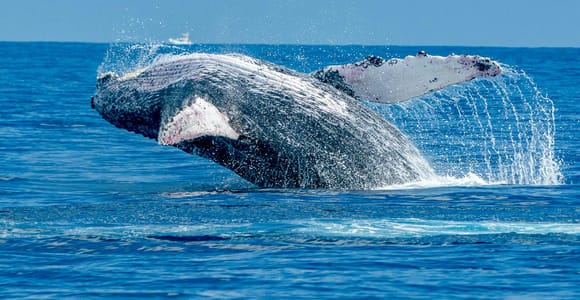
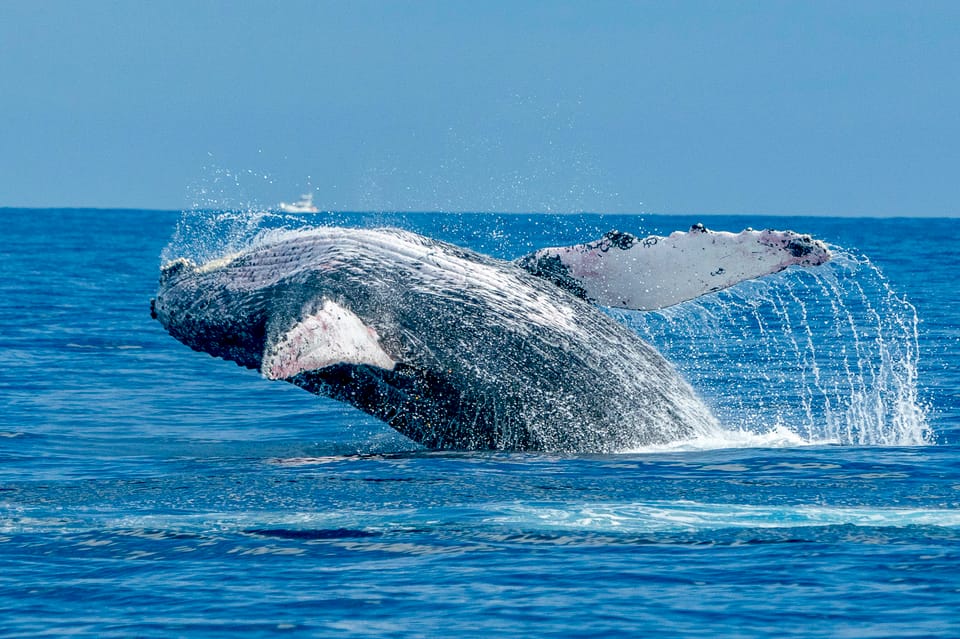
A good February trip off Maʻalaea shows you blows, backs and tails within the first half hour, and possibly a breach — the full-body jump in the photograph at the top of this page. A competition pod, where several males pursue one female at speed, is the thing naturalists get excited about and is not rare at the peak.
A bad December trip shows you two distant blows and a lot of horizon. Operators rarely guarantee sightings in a form worth relying on, and those that offer a free repeat trip are offering you another morning of your holiday, not your money.
Book two hours rather than three. On a good day two hours is plenty, and on a bad day the third hour does not help.